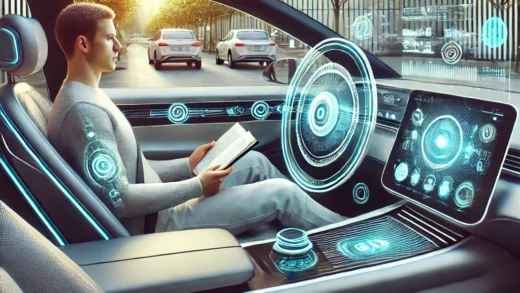
Self-driving cars promise safer roads, greater convenience, and a revolution in mobility. But behind the futuristic headlines lies a critical concern: cybersecurity. As vehicles become increasingly autonomous and connected, they also become tempting targets for hackers. Protecting these rolling computers is now as essential as designing their sensors or AI. The race is no longer just about who builds the smartest car—it’s also about who builds the most secure one.

Why Hackers See Cars as a New Target?
Autonomous vehicles are essentially mobile data centers. They rely on dozens of electronic control units, high-performance chips, sensors like lidar and cameras, GPS, and constant connectivity to the cloud. Each of these is a potential entry point for hackers.
Connectivity, while powerful, increases risk. Cars that communicate with infrastructure, other vehicles, or backend servers expand their “attack surface.” A skilled hacker might intercept signals, inject false data, or even take remote control of key functions. Cyberattacks on traditional cars have already shown how vulnerabilities can allow outsiders to disable brakes or unlock doors. With autonomous cars, the stakes are far higher.
Hackers can also manipulate the very data autonomous systems depend on. For example, if a car’s sensors are tricked into “seeing” an obstacle that isn’t there, it may brake suddenly. Or if GPS signals are spoofed, a car could be misled into driving off course. For criminals, pranksters, or hostile actors, such vulnerabilities are too attractive to ignore.
The Risks Are Real
Consumers around the world are aware of these dangers. Surveys show that more than 70 percent of people are concerned about cyberattacks on autonomous and connected vehicles. This fear is not unfounded.
A cyberattack could disable brakes, hijack steering, or cut off power—all while passengers sit helpless inside. Data privacy is another issue. Cars gather detailed records of journeys, driving habits, and even in-cabin behavior. A breach could expose sensitive personal information.
Even denial-of-service attacks, where hackers overload systems or jam sensors, could create chaos by forcing cars into fail-safe shutdowns. Imagine hundreds of robotaxis suddenly stopping in the middle of a city because their communication channels were overwhelmed.
Supply chain risks add another layer. Modern vehicles rely on hardware and software from countless suppliers. If even one component is compromised before installation, an entire fleet could inherit that weakness.
Why Defense Is So Difficult?
Securing autonomous cars isn’t as simple as installing antivirus software. The challenge starts with complexity. A self-driving car integrates dozens of subsystems—perception, decision-making, control, connectivity—and they must all interact smoothly in real time. A vulnerability in one area can ripple across the whole system.
Timing is another issue. Safety decisions in cars must be made in milliseconds. Security protections like encryption or anomaly detection cannot add delays that might slow braking or evasive action. Defenses need to be strong yet lightweight.
There’s also a lack of standardization across the industry. Different automakers use different software frameworks, communication protocols, and update systems. Without universal standards, it’s difficult to guarantee consistent protection.
Finally, testing for cyber threats is far more complicated than testing for physical crashes. Hackers constantly invent new methods, meaning defenses must evolve continuously. You cannot “finish” cybersecurity—it is an ongoing battle.
How the Industry Is Fighting Back?
Despite the challenges, automakers and regulators are making progress.
Many are adopting a multi-layered defense approach, known as “defense in depth.” This includes secure hardware chips, encrypted communication channels, intrusion detection systems, and redundancy so that one compromised system cannot take down the entire car.
Over-the-air (OTA) updates are another key weapon. Just as smartphones receive security patches, autonomous cars can now download fixes remotely. These updates must themselves be secure, signed, and verified to prevent hackers from hijacking the process.
Artificial intelligence is also being applied to security. Machine learning algorithms can watch for unusual behavior—like a sudden flood of messages on a network or a sensor giving impossible readings—and trigger alerts or safe shutdowns.
Industry standards are starting to emerge. Regulations such as the UNECE’s cybersecurity framework and the ISO/SAE 21434 standard require automakers to design cybersecurity into vehicles from the start. Global collaboration between carmakers, governments, and tech firms is essential to make these protections consistent across borders.
What Consumers Should Expect?
For drivers and passengers, cybersecurity may feel abstract compared to airbags or crash tests. But in the age of autonomous vehicles, it should be just as visible. Consumers should expect transparency from automakers about what data is collected, how it’s used, and how vehicles are protected.
Just as safety ratings are published for crash performance, cybersecurity ratings may become common. Independent audits and certifications will help reassure buyers that the car they are stepping into has been rigorously tested against digital threats.
Regular software updates should also be the norm, not an afterthought. Owners should be encouraged—and sometimes required—to install updates promptly, much like updating a smartphone or laptop.
A Battle That Never Ends
Cybersecurity in autonomous cars is not a one-time project. It is an ongoing contest between defenders and attackers. Hackers will always search for weaknesses, and automakers must stay one step ahead. The consequences of losing this battle are not just financial or reputational—they could be life-threatening.
Yet, with careful design, strong regulation, and global collaboration, the risks can be managed. Autonomous cars can deliver on their promise of safer, cleaner, and more efficient mobility—but only if they are also secure.
The challenge is clear: building trust is as important as building technology. A future where people embrace self-driving cars depends on their confidence that hackers cannot seize the wheel. Winning that trust will require vigilance, innovation, and honesty. In the end, the true race in autonomous driving may not be car versus car, but defenders versus attackers—and the stakes are nothing less than public safety.