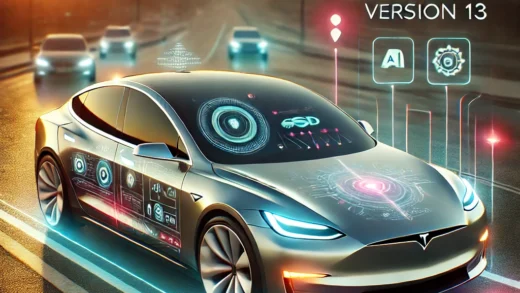
Training a Full Self-Driving (FSD) system requires an extraordinary amount of data. Every lane merge, every pedestrian crossing, every unexpected hazard teaches the system something new. For years, automakers relied mostly on real-world driving to gather this information. But as driving models grow more sophisticated and regulators demand higher levels of safety, collecting enough diverse data from real roads has become too slow, too expensive and too unpredictable.
This is where synthetic driving data steps in. Powered by generative AI, synthetic data creates realistic, high-quality scenarios that cars may rarely encounter in the real world. Think of children running into the street, sudden debris, unusual weather patterns or complex intersections in unfamiliar environments. Creating these scenarios artificially — at scale — speeds up the development of autonomous systems and fills the gaps real-world driving can’t reach.
For Tesla, BYD, NIO and other global EV players, generative AI is becoming a critical tool in the race toward safer, smarter autonomy.

How Generative AI Creates Synthetic Driving Worlds
Generative AI models learn from real inputs — camera footage, sensor data, lidar maps — and then use that understanding to create completely new driving scenarios. These scenes look and behave like real-world footage, but they are generated on demand and tailored to the specific needs of a self-driving model.
Synthetic datasets can include different geographies, traffic cultures, weather conditions, and rare “edge cases” that can be hard to capture with a camera alone. Developers can create a thousand variations of the same scene to help an FSD system learn to generalize better. A robotaxi model might need to understand dozens of different ways a car could cut into a lane, or how pedestrians behave differently in Tokyo, Paris or Los Angeles. With generative AI, these simulations can be produced quickly and continuously.
For EV and AV automakers working in both the U.S. and European markets, synthetic data offers a way to train and validate self-driving systems across entirely different sets of rules, environmental factors, and urban designs. That capability could prove essential as companies try to deploy advanced autonomy globally.
Why Synthetic Data Levels the Playing Field
Real-world data has long been one of Tesla’s biggest competitive advantages. With hundreds of thousands of connected vehicles collecting video from daily drives, Tesla has built one of the world’s largest autonomous-driving datasets. This is difficult for newer players to match.
But synthetic data opens the door for companies without massive fleets to catch up. BYD, NIO and other rising EV brands can use generative AI to produce millions of training miles without deploying thousands of test vehicles. They can even simulate scenarios specifically tailored for their sensor setups, traffic environments or future robotaxi ambitions.
This helps create a more competitive global landscape. Tesla still benefits from fleet data, but rival companies no longer need years of real-world driving to train a strong foundation model. Synthetic environments help them accelerate model training, broaden scenario coverage and reduce the cost of gathering complex, hard-to-find data.
In the U.S. and EU markets, where safety regulations and road conditions vary widely, synthetic training also gives companies flexibility. They can simulate new road signs, unique speed limits, non-standard lane markings or unusual intersections — all without physically testing in every location.
The Strategic Shift: From Hardware Race to Data Race
The next big leap in autonomous driving will be defined less by who has the best sensors or most powerful computer and more by who can train their AI the fastest and most effectively. Synthetic data generation is becoming the heart of this shift.
Companies investing in generative AI benefit from faster development cycles. They can create new test scenarios in minutes, retrain models overnight and validate features before pushing them to customer vehicles. This reduces the time from experiment to deployment and helps identify system weaknesses earlier.
For investors following AV and EV stocks, this marks a turning point. The companies that treat synthetic data as a strategic asset — not just an enhancement — are positioning themselves for long-term dominance. This includes both aggressive innovators like Tesla and rapidly advancing players such as BYD and NIO.
Challenges and Limitations Still Exist
Synthetic data is powerful, but it isn’t perfect. Artificially generated scenes can miss subtle real-world imperfections like unusual shadows, unpredictable human behavior or sensor noise. This is why real-world data remains crucial for validation. The best-performing FSD systems will come from hybrid datasets — blending massive real-world miles with dense synthetic scenarios.
Another challenge is ensuring that synthetic environments behave realistically. Poorly modeled physics or unrealistic interactions could cause a system to learn incorrect behaviors. Automakers must invest heavily in simulation fidelity to ensure synthetic data supports, rather than distorts, model training.
Finally, generative AI requires robust computing power and well-designed pipelines. Not every automaker has the resources or expertise to build these systems quickly. That reality may create a new divide between technologically advanced companies and slower-moving manufacturers.
What Comes Next in the FSD Arms Race
Generative AI for synthetic driving data is transforming the global competition for autonomous vehicles. As Tesla, BYD, NIO and others scale their AI training pipelines, synthetic data will become a core differentiator — not a niche tool. The companies capable of producing the richest, most realistic datasets will gain a meaningful lead in autonomy development.
In the U.S. and Europe, where regulators demand rigorous safety validation, synthetic data will also help automakers meet high compliance standards. From edge-case coverage to environmental diversity, simulated worlds offer a scalable path to safer FSD deployment.
The future of autonomous driving will not be won on hardware alone. It will be won by those who master the art of generating, training and validating data at unprecedented scale. Synthetic data is no longer an experiment — it’s the new battlefield in the race toward true autonomy.