The race to perfect autonomous driving technology has captured the attention of the automotive and tech industries alike, with Tesla and Waymo emerging as the two leading players. Each company approaches autonomy with unique strategies, technologies, and goals, making it an intriguing rivalry. As the US and Europe prepare for a future shaped by self-driving cars, the question remains: Who will dominate the autonomous tech market?
Tesla’s Vision: Autonomy for the Masses
Tesla has always been a disruptor, and its approach to autonomous technology reflects the company’s innovative spirit. Tesla’s Autopilot and Full Self-Driving (FSD) systems are designed to bring advanced driver-assistance features to the masses. Unlike other companies that focus solely on high-level autonomy, Tesla has adopted a step-by-step strategy, gradually introducing new capabilities through over-the-air updates.
Tesla’s approach is rooted in its vast fleet of vehicles equipped with hardware capable of full autonomy. These cars collect massive amounts of real-world data from roads across the US, Europe, and beyond. This data is used to train Tesla’s AI, allowing it to improve its decision-making capabilities in real-world conditions. Tesla’s belief is that the key to solving autonomy lies in data scale and AI-driven software.
What sets Tesla apart is its reliance on a vision-based system. By using cameras and neural networks, Tesla aims to achieve full autonomy without lidar, which it considers unnecessary and expensive. This decision has sparked debate within the industry, but Tesla’s confidence in its camera-based approach remains steadfast.
Waymo’s Approach: Precision and Safety First
Waymo, born out of Google’s self-driving car project, takes a different path. Focused on delivering Level 4 and Level 5 autonomy, Waymo is building a system designed to operate without human intervention in specific conditions or geofenced areas. Waymo’s goal is to create a fleet of autonomous vehicles for ride-hailing, logistics, and public transport.
Waymo’s technology relies on a combination of lidar, radar, and cameras to achieve a detailed understanding of the environment. This multi-sensor approach allows Waymo to map its surroundings with extreme precision, a critical factor in navigating complex urban environments. Safety is at the core of Waymo’s strategy, and the company has logged billions of miles in both real-world and simulated environments to ensure its systems are reliable.
Unlike Tesla, which focuses on selling cars to individual consumers, Waymo is prioritizing shared mobility solutions. By deploying autonomous ride-hailing services in select cities, Waymo is demonstrating how its technology can reshape urban transportation.
The US vs. European Landscape
Tesla and Waymo operate in regions with distinct regulatory landscapes and market conditions. In the US, both companies benefit from supportive policies that encourage innovation in autonomous technology. States like California and Arizona have become testing grounds for self-driving cars, allowing both Tesla and Waymo to gather crucial data and refine their systems.
In Europe, the regulatory environment is more cautious, with strict safety standards and requirements for public road testing. Tesla has made significant inroads into the European market by offering advanced driver-assistance features, but its Full Self-Driving system faces more scrutiny due to regulatory concerns. Waymo, meanwhile, has been slower to expand into Europe, focusing primarily on the US market.
Despite these challenges, both companies are poised to make a significant impact on the European market as regulations evolve to accommodate autonomous vehicles.
Strengths and Challenges
Tesla’s strengths lie in its scale and data-driven approach. With millions of vehicles on the road, Tesla has access to an unparalleled data set, enabling rapid improvements to its AI. Its over-the-air updates allow Tesla to continuously refine its systems, keeping customers engaged and informed.
However, Tesla’s vision-based approach has its critics. Many experts argue that lidar provides an additional layer of safety and redundancy, which is especially important for achieving full autonomy. Tesla also faces regulatory hurdles in both the US and Europe, where the term “Full Self-Driving” has been met with skepticism.
Waymo’s key strength is its multi-sensor approach, which prioritizes safety and reliability. By focusing on autonomous ride-hailing, Waymo is targeting a specific market segment where its technology can have a transformative impact. Its partnerships with local governments and transportation agencies also position it as a trusted leader in the industry.
Waymo’s challenge lies in scaling its technology for broader use. The reliance on expensive lidar systems and the need for detailed mapping of new areas limit its expansion. Additionally, its focus on geofenced areas means that Waymo’s technology is not yet ready for widespread, unrestricted use.
The Road Ahead
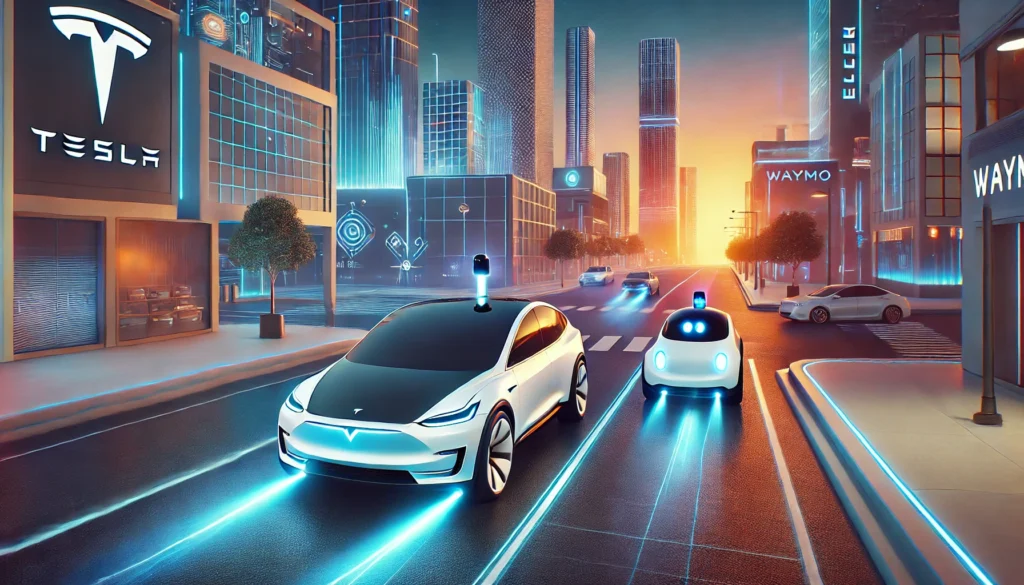
Tesla and Waymo represent two distinct visions for the future of autonomous vehicles. Tesla’s consumer-focused approach emphasizes affordability, scalability, and rapid iteration, while Waymo’s precision-driven strategy prioritizes safety and shared mobility.
As the US and Europe move closer to embracing autonomous vehicles, the winner of this race will likely depend on market demand, regulatory developments, and technological breakthroughs. Tesla’s ambition to deliver autonomy for the masses and Waymo’s commitment to redefining urban mobility are both shaping the future of transportation.
In the end, the competition between Tesla and Waymo isn’t just about who will dominate autonomous tech—it’s about how these innovations will transform the way we live, work, and move in the decades to come.