The race to deploy autonomous vehicles (AVs) on roads worldwide is in full swing, and regulatory frameworks play a critical role in shaping how and when this technology will become mainstream. Both the United States and Europe are at the forefront of this revolution, but their approaches to regulating autonomous vehicles differ significantly. As we move through 2025, these differences highlight the unique priorities, challenges, and opportunities in each region.
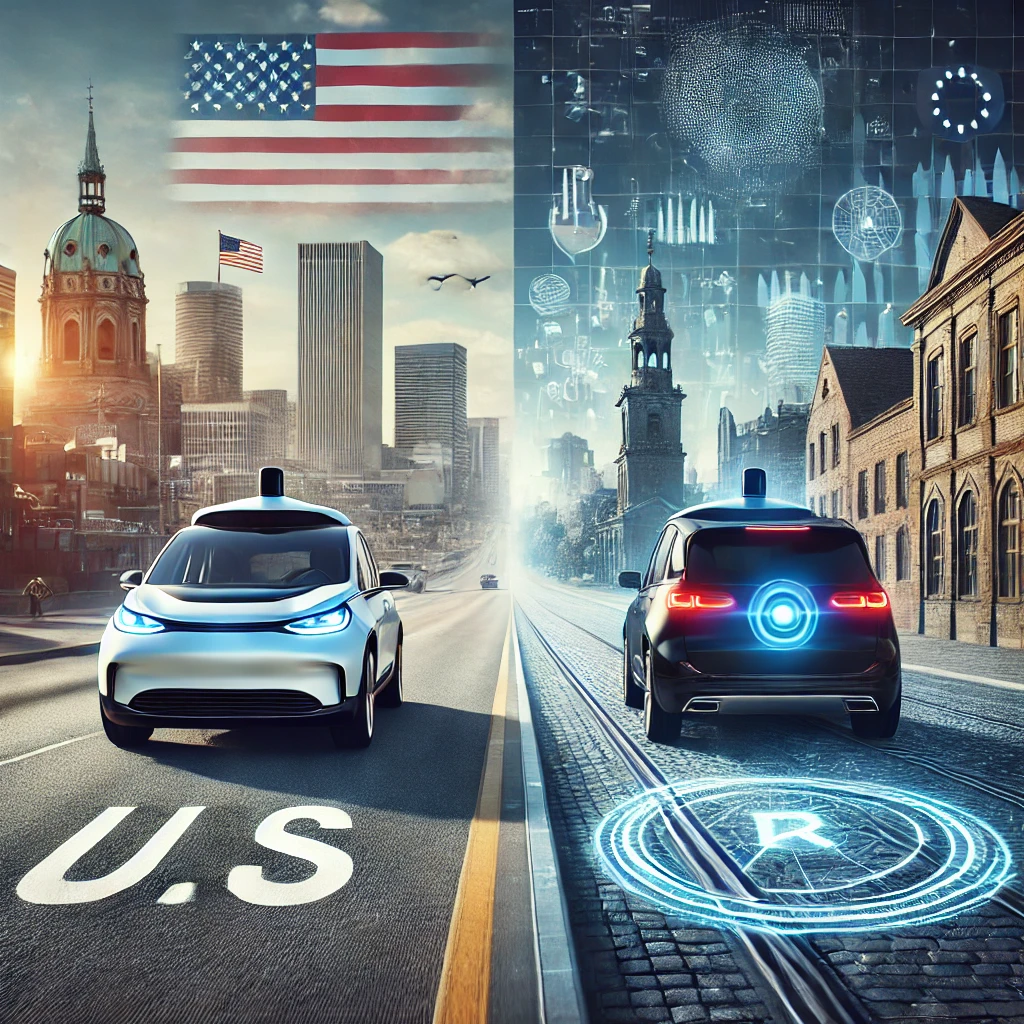
The U.S. Approach: Innovation First
The United States has positioned itself as a global leader in autonomous vehicle technology, largely due to its innovation-driven regulatory environment. In the U.S., AV regulations are primarily managed at the state level, with federal guidelines acting as a loose framework. This decentralized approach allows states to tailor their policies based on local needs while fostering a competitive environment for tech companies and automakers.
Federal agencies like the National Highway Traffic Safety Administration (NHTSA) provide guidance and safety standards, but they have avoided imposing stringent rules that might stifle innovation. For example, the NHTSA’s 2025 updates to its Automated Driving Systems (ADS) guidelines emphasize flexibility, encouraging companies to test and deploy AVs with minimal federal interference.
This light-touch approach has enabled companies like Tesla, Waymo, and Cruise to rapidly test and deploy their autonomous technologies in cities like San Francisco, Phoenix, and Austin. However, it also creates challenges in ensuring consistent safety standards across states. For instance, while California has strict AV testing requirements, states like Texas offer more relaxed regulations, creating a patchwork of rules that can be confusing for companies and consumers alike.
Europe’s Strategy: Safety and Standardization
In contrast, Europe takes a more centralized and safety-focused approach to autonomous vehicle regulation. The European Union (EU) has established a comprehensive framework that applies uniformly across member states, ensuring consistency and predictability for automakers and tech companies operating within the region.
The EU’s General Safety Regulation (GSR), updated in 2022 and actively enforced in 2025, mandates advanced safety features for all new vehicles, including autonomous systems. These include requirements for driver monitoring, emergency lane-keeping, and collision avoidance technologies. The GSR also introduces a tiered system for AV deployment, aligning with the Society of Automotive Engineers’ (SAE) levels of automation, which range from Level 0 (no automation) to Level 5 (fully autonomous).
Europe’s cautious and safety-first approach reflects its cultural and legal priorities. By focusing on rigorous testing and standardization, the EU aims to build public trust in autonomous technology. This emphasis on safety does, however, slow the pace of deployment compared to the U.S., where companies can quickly move from testing to commercial operations.
Key Differences in Liability and Ethics
One of the most striking differences between U.S. and European AV regulations is how liability is addressed. In the U.S., liability for accidents involving autonomous vehicles often falls on manufacturers, but state laws can vary widely. Europe, on the other hand, has implemented clearer rules under its Product Liability Directive, holding manufacturers accountable for ensuring their vehicles operate safely under all conditions.
Ethical considerations also play a prominent role in Europe’s regulatory framework. The EU’s ethical guidelines for AI in autonomous vehicles prioritize transparency, accountability, and the prevention of bias in decision-making algorithms. While the U.S. does emphasize ethical AI, its guidelines are less prescriptive, allowing companies more freedom to develop their systems.
Challenges and Opportunities for the Future
Both the U.S. and Europe face unique challenges in regulating autonomous vehicles. In the U.S., the lack of federal uniformity can hinder large-scale deployment and create regulatory uncertainty for companies operating across state lines. Conversely, Europe’s highly standardized but cautious approach may delay the adoption of autonomous technologies, potentially putting it at a competitive disadvantage in the global market.
Despite these challenges, the future of AV regulation in both regions holds immense promise. In the U.S., ongoing collaboration between federal agencies, state governments, and industry leaders is paving the way for more cohesive policies. Meanwhile, Europe’s rigorous safety standards and ethical guidelines could set a global benchmark for responsible AV deployment.
Striking a Balance
As autonomous vehicles continue to evolve, the balance between innovation and safety remains crucial. The U.S. and Europe each bring valuable perspectives to this global conversation. While the U.S. fosters rapid technological advancement, Europe emphasizes the importance of building public trust through consistent and robust safety measures.
For automakers, tech companies, and consumers, understanding these regulatory differences is key to navigating the future of autonomous transportation. As the world watches, both regions are shaping the future of mobility in their own distinct ways, ensuring that autonomous vehicles can safely and effectively transform how we travel.
Conclusion
The contrasting regulatory approaches of the U.S. and Europe highlight the diverse paths to integrating autonomous vehicles into our daily lives. In the U.S., innovation takes center stage, driving rapid advancements in AV technology. In Europe, a standardized and safety-centric framework ensures a cautious but responsible rollout. Together, these strategies are driving the global adoption of autonomous vehicles, offering valuable lessons for the rest of the world. As we enter a new era of transportation, the synergy between innovation and regulation will define the future of autonomous driving.