The modern vehicle is no longer a closed mechanical system. It is a connected, software-defined platform powered by advanced processors, intelligent sensors, and cloud-based services. From collision avoidance to predictive maintenance, today’s cars rely on a mix of onboard computing and remote cloud infrastructure. The key question facing automakers in the US and European markets is simple but strategic: what should run inside the vehicle, and what should run in the cloud?
This decision process is known as partitioning. It defines how tasks are distributed between the vehicle’s real-time systems and external cloud platforms. Getting this balance right ensures safety, performance, cost efficiency, and regulatory compliance. Getting it wrong can lead to latency issues, higher costs, or compromised user experience.
Why Partitioning Matters More Than Ever
Vehicles today generate enormous amounts of data. High-resolution cameras, radar, lidar, driver monitoring systems, and connectivity modules stream information constantly. Central compute units analyze this data to support advanced driver assistance systems and emerging autonomous features. At the same time, vehicles connect to backend systems for updates, diagnostics, and digital services.
In the US and EU, where regulations around safety, cybersecurity, and privacy are strict, partitioning decisions must align with compliance requirements. Safety-critical tasks cannot rely on network availability, while data privacy rules influence how information is transmitted and stored. The architecture must guarantee reliability even in areas with limited connectivity.
Partitioning is not just about technology. It shapes cost structures, customer satisfaction, and long-term scalability. As vehicles become smarter, defining what runs locally versus remotely becomes central to automotive strategy.
What Must Run Real-Time in the Vehicle
Certain tasks can never depend on the cloud. Safety-critical systems such as automatic emergency braking, lane-keeping assist, adaptive cruise control, and collision detection require immediate decision-making. These functions operate within milliseconds and must perform predictably under all driving conditions.
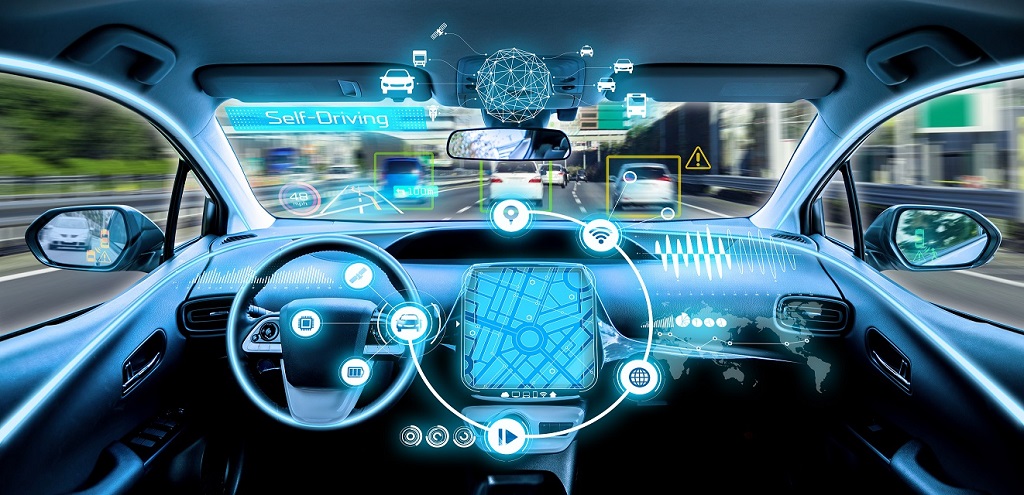
Centralized compute platforms inside the vehicle handle sensor fusion and perception tasks. Cameras and radar feeds are processed locally by CPUs, GPUs, and neural processing units. These processors interpret the environment, classify objects, and calculate vehicle responses without relying on an external signal.
Deterministic performance is the core reason these workloads stay onboard. Cellular networks, even advanced 5G systems, cannot guarantee zero latency or perfect coverage. A dropped signal during a critical maneuver is unacceptable. That is why advanced driver assistance and autonomous features are designed to operate independently of cloud connectivity.
Privacy regulations in Europe, particularly around sensitive driver data, also encourage local processing. Video feeds and biometric monitoring often remain inside the vehicle unless anonymized and summarized before transmission.
What the Cloud Does Best
While the vehicle excels at real-time processing, the cloud excels at scale. Cloud platforms can store vast amounts of data, run complex analytics across millions of vehicles, and continuously improve machine learning models. Tasks that benefit from aggregated data and historical analysis are ideal for cloud execution.
Predictive maintenance is a strong example. By analyzing fleet-wide data, cloud systems can detect patterns that signal potential component failures before they occur. This allows automakers to notify drivers proactively and reduce warranty costs.
Over-the-air software updates also rely heavily on cloud infrastructure. Manufacturers can deploy security patches, feature upgrades, and performance enhancements remotely. In competitive US and EU markets, this ability to evolve vehicle capabilities over time is a major differentiator.
Cloud computing also supports personalized services. Navigation systems can leverage real-time traffic data and historical driving patterns to deliver optimized routes. Voice assistants and digital ecosystems integrate seamlessly through backend services that continuously refine user experiences.
Latency, Bandwidth, and Cost Considerations
Partitioning decisions are influenced by three critical factors: latency, bandwidth, and cost. Real-time safety systems demand ultra-low latency, which means local execution. Tasks that can tolerate delay are candidates for cloud processing.
Bandwidth is another important factor. Transmitting raw sensor data continuously to the cloud would require enormous network capacity and drive up operational costs. Instead, vehicles preprocess data locally and send only relevant summaries or event-based information.
Cost efficiency also shapes partitioning strategies. Onboard compute hardware is expensive and must meet automotive-grade reliability standards. Cloud infrastructure spreads computational cost across millions of users but incurs recurring service expenses. The optimal architecture balances these trade-offs carefully.
A Hybrid Model for Modern Vehicles
The most effective automotive architectures embrace a hybrid model. Vehicles handle real-time and safety-critical functions locally while leveraging the cloud for analytics, updates, and large-scale optimization. This collaboration between edge and cloud creates a powerful ecosystem.
Machine learning models are often trained in the cloud using massive datasets. Once optimized, these models are deployed back to vehicles for local inference. This cycle allows fleets to improve continuously without sacrificing real-time responsiveness.
In both the US and European markets, hybrid partitioning strategies also support regulatory compliance and cybersecurity resilience. Vehicles maintain independence for safety operations while benefiting from cloud intelligence for continuous improvement.
Designing for the Future
As vehicles move toward higher levels of autonomy, partitioning strategies will become even more important. Compute demands will increase, and connectivity will expand. Engineers must design flexible architectures that allow workloads to shift intelligently between vehicle and cloud environments.
Future vehicles may dynamically adjust partitioning based on connectivity strength or workload demands. However, the principle will remain constant: safety and time-critical functions stay onboard, while scalable analytics and personalization thrive in the cloud.
Partitioning is ultimately about delivering performance that feels seamless to the driver. When executed correctly, drivers never notice where the processing happens. They simply experience responsive safety systems, intelligent navigation, and evolving digital features.
In the age of software-defined vehicles, understanding what runs real-time in the car versus the cloud is more than a technical choice. It is a strategic decision that shapes safety, efficiency, and innovation across the automotive ecosystem.