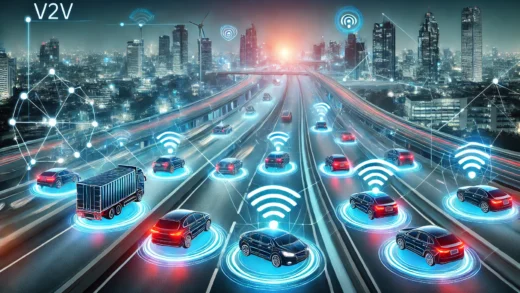
Autonomous driving is no longer just about sensors and silicon. It has become a global competition between technological philosophies. On one side stands Tesla with its bold, streamlined vision-only approach, where each vehicle relies entirely on its own cameras, neural networks, and onboard computing. On the other side, European researchers and automakers are investing heavily in cooperative perception, a model where vehicles, infrastructure, and even pedestrians’ devices share information to create a connected “collective brain” for safer automated driving.
This contrast has triggered an important question for the US and EU automotive markets: can Europe’s cooperative-perception projects meaningfully erode Tesla’s long-standing software moat? Or will Tesla’s independent strategy remain dominant in an increasingly connected world?

Understanding Europe’s Push for Cooperative Perception
Cooperative perception, often called CP, is the idea that vehicles shouldn’t navigate the world alone. Instead, they gain awareness from surrounding cars, roadside sensors, and smart infrastructure that continuously broadcast information about traffic, hazards, road conditions, and vulnerable road users.
In a dense European city, this connected ecosystem can give autonomous vehicles a powerful advantage. A car might detect a cyclist hidden behind a parked van thanks to a message from another vehicle. A smart traffic light might warn of a pedestrian stepping into a crosswalk before any onboard camera notices. Vehicles can “see” around corners and react earlier to fast-developing situations.
For Europe, where cities are older, roads narrower, and mixed-traffic environments more complex than typical American suburbs, CP is more than an upgrade. It is a necessity for large-scale, safe deployment of automated mobility. That is why EU governments, research institutions, and major OEMs are building frameworks, testing corridors, and data-sharing platforms dedicated to cooperative systems.
This collaborative approach promises improved safety, reduced congestion, and more predictable behavior in chaotic urban scenarios. It also allows multiple brands and infrastructure systems to share data, creating a network effect that grows more powerful as more participants join.
Tesla’s Solo Vision Stack and Why It Works
Tesla, by contrast, has doubled down on simplicity. Its vehicles operate using a “vision-only” stack supported by neural networks trained on billions of real-world driving miles. No lidar, minimal radar, and no reliance on external infrastructure. Tesla’s philosophy is clear: a car should be able to drive anywhere, anytime, using only the sensors it carries.
This end-to-end strategy has advantages, especially in markets like the US where V2X infrastructure is slow to roll out. Tesla can deploy improvements instantly to its entire fleet via over-the-air updates, keeping its software unified and scalable. Without needing roadside sensors or standardized communication protocols, its AV functionality remains portable across countries and road environments.
Tesla’s moat comes from this autonomy in design. Its system does not depend on city planners, telecom networks, or government-funded infrastructure. The vehicle itself holds the intelligence. For buyers in environments where connected infrastructure is limited, this independence is highly appealing.
Yet the solo stack has limits. Cameras can be blinded by glare or heavy rain. A vehicle cannot see around obstacles or predict the hidden actions of road users in cluttered environments. Urban settings — especially the kind found in Europe — generate many of the edge cases that continue to challenge vision-only systems.
Will Cooperative Perception Shrink Tesla’s Lead?
Europe’s investment in cooperative perception creates a new competitive dynamic. If CP becomes widely deployed, the advantage may shift from stand-alone intelligence to collective intelligence. A Tesla relying solely on its onboard sensors would lack access to the richer, early-warning data that connected vehicles would enjoy.
This is where Tesla’s moat could start to narrow. When a connected vehicle can detect an unseen hazard before any camera could possibly capture it, the safety gap may favor CP-enabled systems. In markets where cities fund the rollout of smart infrastructure — such as connected intersections, road-side lidar, and V2X communication hubs — European OEMs might gain a strategic edge without needing to match Tesla’s enormous data-driven neural network.
Moreover, cooperative systems grow stronger with adoption. The more cars, buses, and roadside units participate, the more accurate and reliable the shared awareness becomes. This network effect could create a competitive moat of its own, one that Tesla may struggle to benefit from unless it adopts compatible technologies.
Challenges That Slow Down Europe’s Progress
Still, cooperative perception faces real hurdles. It depends on infrastructure investment, regulatory alignment, cybersecurity standards, and broad adoption by multiple automakers. If only a small percentage of vehicles support CP, its benefits remain limited. These challenges could delay CP’s widespread implementation, especially outside major metropolitan areas.
This gives Tesla breathing room. In many regions, especially across the US, infrastructure projects progress slowly. Tesla’s independence from such systems keeps its technology relevant even in places where connected-road networks may take years to mature.
A Future of Convergence Rather Than Competition
Despite their differences, the future of autonomous mobility may require both approaches. Vision-based intelligence offers flexibility and global scalability. Cooperative perception delivers unmatched awareness and safety in dense, unpredictable urban environments. The most advanced systems may eventually blend both: strong onboard perception supported by connected, real-time environmental data whenever available.
If Europe succeeds in deploying CP at scale, Tesla’s software moat may shrink — not because its system weakens, but because the connected ecosystem around it grows stronger. At the same time, Tesla’s robust solo stack will remain valuable in regions where CP adoption lags.
The road ahead is not a battle between two philosophies but a gradual merging of both. Whether through competition or eventual cooperation, the future of autonomous driving will likely be both smarter individually and wiser collectively.