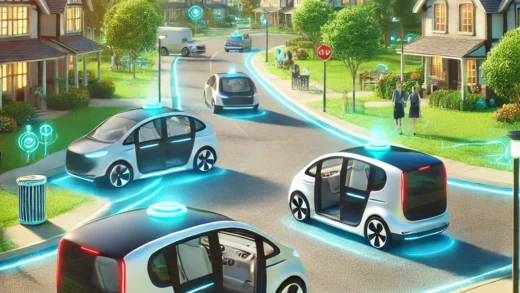
China is leading a quiet revolution in the way cities move. Across the country, smart city projects are transforming roads, communication networks, and urban systems to make autonomous vehicles (AVs) not just possible—but practical. What makes this transformation remarkable is the strong hand of government leadership. By investing in infrastructure and policy, China is building the foundation for large-scale AV adoption and redefining how people and goods move in its cities.

The Road to Smart Mobility
In China, the concept of a “smart city” goes far beyond digital traffic lights or electric buses. It’s about creating a connected ecosystem where vehicles, roads, and cloud systems communicate seamlessly. This synergy is powered by Vehicle-to-Everything (V2X) technology, 5G networks, and intelligent road infrastructure.
Major cities such as Beijing, Shanghai, Guangzhou, and Shenzhen have launched autonomous driving demonstration zones, transforming selected districts into testbeds for driverless innovation. These zones feature hundreds of kilometers of roads equipped with sensors, high-definition cameras, lidar units, and smart traffic signals. Each element feeds real-time data into centralized city platforms, allowing vehicles to “see” beyond their immediate environment. This infrastructure doesn’t just enhance safety—it helps AVs operate smoothly even in the dense traffic and complex road layouts that define Chinese cities.
Government Leadership and Vision
Unlike many markets where autonomous vehicle testing is left to private companies, China’s AV journey is being driven by government vision and policy. The Ministry of Industry and Information Technology, the Ministry of Transport, and local city governments are all collaborating to ensure AV adoption aligns with national goals for innovation, safety, and sustainability.
More than fifty Chinese cities have issued detailed rules governing intelligent connected vehicles, defining how roads must be built to support AV technology. New or upgraded roads are now required to include digital infrastructure compatible with autonomous driving systems. Government-backed pilot projects in cities like Wuhan and Chongqing have even begun approving limited driverless commercial operations, signaling growing regulatory confidence.
This top-down approach gives automakers and technology firms the stability and clarity they need to invest. Companies such as Baidu, Pony.ai, and AutoX have been expanding robotaxi services, often in partnership with municipal governments that provide access to smart infrastructure and data platforms.
Smart Roads and Data Ecosystems
The backbone of China’s AV revolution is its “vehicle-road-cloud” system. Instead of relying solely on onboard sensors, vehicles share information with roadside units and data centers. This helps cars anticipate upcoming hazards, traffic jams, and changes in road conditions. For instance, if one autonomous vehicle detects a sudden slowdown, that information can be instantly transmitted through the cloud to others nearby, preventing accidents and congestion.
Cities are also developing high-precision mapping systems to support autonomous navigation. These digital maps, updated in real time, guide vehicles more accurately than GPS alone. When combined with 5G networks, the latency between road sensors, vehicles, and control centers drops dramatically, enabling AVs to make safer, faster decisions.
Real-World Deployment and Public Impact
China’s commitment to infrastructure is paying off. Autonomous shuttles and robotaxis are already ferrying passengers in several cities. These services operate within geofenced smart zones where roads are equipped with full V2X connectivity. A few pilot regions have even integrated autonomous buses into public transport networks, showing that smart infrastructure can support not just private mobility but also mass transit.
This shift is not just technological—it’s social. AV adoption is improving urban safety and reducing congestion, while also supporting China’s carbon-neutral ambitions. With fewer traffic jams and optimized driving patterns, smart mobility can cut fuel use and emissions. For citizens, it promises cleaner air, shorter commutes, and more efficient city logistics.
Challenges and Opportunities Ahead
Despite rapid progress, the journey toward full AV integration isn’t without challenges. Retrofitting existing roads with smart infrastructure remains costly and complex. Different cities may use varying technical standards, making nationwide interoperability an ongoing concern. There are also questions about cybersecurity and data privacy in connected systems.
Still, these hurdles haven’t slowed momentum. The government continues to push for unified standards and stronger data protection frameworks. As technology improves and costs decline, smart infrastructure will become a natural part of urban development plans, extending beyond major cities into smaller regions.
The Future of Autonomous Urban Mobility
The next chapter for China’s smart cities will focus on scaling up. The goal is to move from pilot projects to fully integrated citywide operations. As 5G, artificial intelligence, and edge computing continue to advance, autonomous vehicles will interact more naturally with infrastructure and other vehicles. Data from millions of connected cars will feed into smart-city platforms that optimize everything from traffic flow to energy consumption.
For automakers and mobility companies, China’s approach offers a clear roadmap: collaborate with governments, align with infrastructure plans, and build vehicles that thrive in connected environments. The success of AV adoption here will depend as much on policy and planning as on technology itself.
Conclusion
China’s smart city movement shows how powerful government-led infrastructure can be in shaping the future of mobility. By investing in intelligent roads, V2X communication, 5G networks, and clear regulations, China is creating an environment where autonomous vehicles can flourish safely and efficiently. This collaboration between public policy and private innovation is setting the stage for the world’s largest connected mobility ecosystem.
As more cities embrace this model, the line between vehicles and infrastructure will continue to blur—paving the way for a truly smart, autonomous, and sustainable urban future.