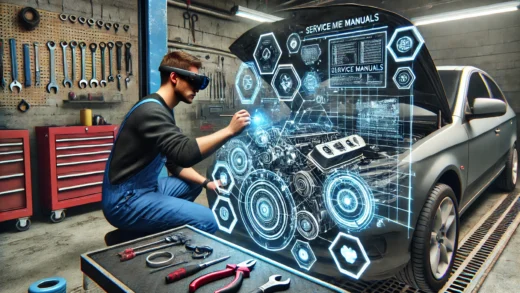
In Europe, the car industry is entering its most transformative phase since the invention of the combustion engine. The shift from mechanical innovation to digital intelligence is reshaping how cars are designed, built, and experienced. Instead of being defined by horsepower and hardware, the modern European car is now defined by software. This evolution has given rise to the software-defined vehicle (SDV) — a connected, updateable, and intelligent machine that continues to evolve long after leaving the factory.
Leading this transformation are two of Germany’s most influential automotive powerhouses: Volkswagen Group, through its software division CARIAD, and Mercedes-Benz, through its proprietary platform MB.OS. Both companies are investing billions to ensure Europe remains at the forefront of the global mobility shift. Their goal isn’t just to make better cars — it’s to make smarter ones.

VW’s CARIAD: Building the Software Spine of the Volkswagen Group
Volkswagen’s answer to the SDV challenge is CARIAD, an independent software company within the VW Group created to unify and modernize the software across its many brands — from Audi and Porsche to Škoda and Volkswagen itself. The vision behind CARIAD is ambitious: to create a shared software architecture known as VW.OS, capable of supporting all group vehicles and powering everything from infotainment to automated driving.
This system gives Volkswagen control over its software destiny. Instead of relying on external tech suppliers, VW now develops the core software stack internally — giving it the ability to deliver over-the-air (OTA) updates, roll out new driver-assistance features, and introduce app-based services directly to customers. Essentially, it allows cars to grow smarter and safer over time, much like smartphones receive regular updates.
For European drivers, this shift has practical benefits. Cars equipped with VW.OS can gain new features after purchase, such as improved navigation tools, enhanced safety systems, or personalized infotainment services. CARIAD also aims to make the driving experience consistent across brands, so whether you’re in an Audi e-tron or a Volkswagen ID model, the digital experience feels unified and intelligent.
Of course, building such a massive platform has not been without challenges. Integrating different vehicle systems, managing data security, and synchronizing multiple brands require enormous effort. CARIAD has faced delays in delivering its next-generation platform, but recent reports show steady progress, with the next wave of VW electric vehicles set to benefit from its new architecture. In Europe’s competitive market, CARIAD remains one of the most ambitious SDV projects underway.
Mercedes MB.OS: The Premium Path to Digital Luxury
While Volkswagen is scaling software across multiple brands, Mercedes-Benz is redefining what luxury means in a digital age. Its software platform, MB.OS, is the backbone of Mercedes’ strategy to create a connected, intelligent, and adaptive driving ecosystem.
Developed entirely in-house, MB.OS is a chip-to-cloud system — meaning it links every domain of the car, from infotainment and autonomous driving to safety and power management. This tight integration allows Mercedes to control how hardware and software interact, ensuring seamless performance and long-term reliability.
For drivers across Europe, MB.OS brings practical innovation to the road. It powers the next generation of MBUX infotainment, enables advanced driver-assistance systems, and supports OTA updates that continuously enhance the vehicle. With built-in AI, cloud connectivity, and personalized user profiles, MB.OS is designed to understand driver preferences and adapt automatically — from seat comfort to navigation routes.
Mercedes’ approach focuses on premium differentiation. Rather than competing on scale, it aims to deliver a superior digital experience — smooth interfaces, intuitive voice control, and real-time data-driven intelligence. It’s software luxury, delivered the Mercedes way.
By developing its own operating system, Mercedes also keeps data ownership in-house, maintaining a direct relationship with customers instead of handing it off to tech suppliers. This independence gives it an edge in Europe, where privacy, data protection, and digital sovereignty are core consumer values.
Two German Giants, One Digital Destiny
Volkswagen and Mercedes are taking different routes toward the same goal — full software-defined mobility — and together they symbolize Germany’s bold leadership in Europe’s SDV revolution. Volkswagen, with CARIAD and VW.OS, focuses on scale and standardization, building a software foundation that can serve millions of vehicles. Mercedes, through MB.OS, focuses on exclusivity and precision, crafting a bespoke digital experience for each driver.
Both approaches are reshaping what European drivers can expect from their cars. Gone are the days when vehicle features were frozen at purchase. With platforms like MB.OS and VW.OS, cars now receive updates and new capabilities long after they hit the road. This makes ownership more dynamic, extends the lifespan of vehicles, and allows automakers to introduce subscription-based services for premium features — a business model that’s growing rapidly across Europe.
Why It Matters for European Drivers?
For European consumers, these software ecosystems signal a new age of driving. Cars are becoming smarter, more connected, and increasingly customizable. Over-the-air updates mean fewer dealership visits, and software upgrades can enhance everything from safety systems to entertainment features.
More importantly, the rise of SDVs strengthens Europe’s position in the global tech race. Instead of ceding control to Silicon Valley or Asian tech suppliers, German automakers are investing in homegrown digital ecosystems that combine automotive heritage with software innovation. This ensures Europe remains competitive in both mobility and data-driven technologies.
The Road Ahead
As CARIAD and MB.OS continue to evolve, they’re shaping the future of the European automotive market — one that prioritizes connectivity, sustainability, and intelligence. Volkswagen’s software ecosystem aims to democratize advanced technology across its entire brand family, while Mercedes continues to define what digital luxury feels like.
Both represent more than just new technology — they mark the start of a new mindset. The European car is no longer defined by the sound of its engine but by the intelligence of its code.
In this new era of software-defined mobility, Germany’s bold bets are steering Europe into a smarter, more connected future — one software update at a time.