In today’s rapidly evolving automotive landscape, sustainability has shifted from being a buzzword to a fundamental principle guiding car production. The concept of a circular economy is at the forefront of this transformation, particularly in the United States, where innovative approaches to full lifecycle vehicle recycling are redefining the future of transportation. Let’s explore how the circular economy is revolutionizing car production and what it means for consumers and the environment alike.
Understanding Circular Economy in the Automotive Industry
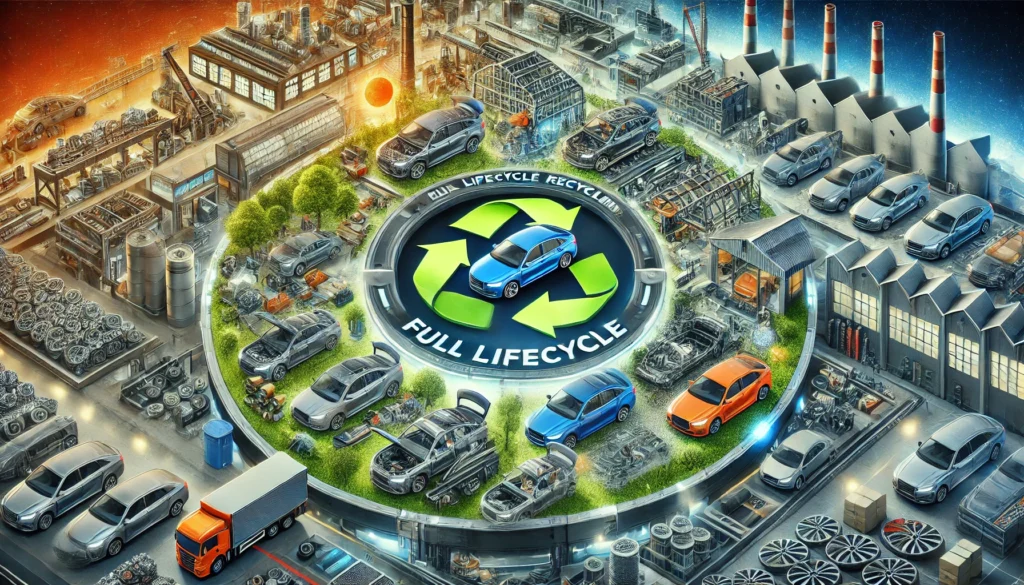
The circular economy model contrasts sharply with the traditional linear economy, which follows a take-make-dispose pattern. Instead, it emphasizes reducing waste, reusing materials, and recycling components to create a closed-loop system. In the context of car production, this means designing vehicles with their entire lifecycle in mind—from manufacturing to end-of-life disposal.
By integrating circular principles, automobile manufacturers are focusing on sustainability from the ground up. This involves selecting recyclable materials, designing for easy disassembly, and ensuring that each component can be repurposed or recycled at the end of the vehicle’s life. This holistic approach not only minimizes environmental impact but also fosters innovation and efficiency within the industry.
Benefits of Full Lifecycle Vehicle Recycling
Full lifecycle vehicle recycling offers numerous advantages that extend beyond environmental benefits. For one, it significantly reduces the demand for raw materials, conserving natural resources and lowering the carbon footprint associated with extracting and processing these materials. Metals like steel and aluminum, commonly used in car manufacturing, can be recycled repeatedly without losing their integrity, making them ideal for sustainable practices.
Moreover, recycling programs create economic opportunities by developing new markets for recycled materials and generating jobs in the recycling sector. Consumers also benefit as recycled materials can lead to cost savings in vehicle production, potentially lowering the price of new cars. Additionally, embracing a circular economy can enhance a company’s reputation, attracting environmentally conscious customers and investors.
How the US is Leading the Charge
The United States is at the forefront of implementing circular economy practices in the automotive industry. Leading car manufacturers are investing heavily in research and development to improve recycling technologies and develop more sustainable materials. For example, major players like Tesla and Ford are pioneering the use of recycled plastics and metals in their vehicle production processes.
Government policies and incentives are also playing a crucial role in promoting full lifecycle vehicle recycling. The Environmental Protection Agency (EPA) has introduced regulations that encourage manufacturers to adopt sustainable practices and invest in recycling infrastructure. Additionally, state-level initiatives, such as California’s Zero Emission Vehicle (ZEV) program, are driving the adoption of eco-friendly technologies and circular economy principles across the industry.
Innovations Driving Circular Practices
Technological advancements are key to advancing the circular economy in car production. Innovations in material science are enabling the development of new, recyclable materials that maintain the high performance standards required for modern vehicles. For instance, bio-based plastics and composites are being explored as alternatives to traditional petroleum-based materials, offering a more sustainable option without compromising on quality.
Advanced recycling technologies, such as automated disassembly systems and chemical recycling processes, are also enhancing the efficiency and effectiveness of vehicle recycling. These technologies allow for the precise separation of different materials, ensuring that each component can be recycled with minimal waste. Additionally, digital tools and data analytics are improving the tracking and management of materials throughout a vehicle’s lifecycle, making it easier to implement circular practices on a large scale.
Challenges and Future Outlook
Despite the promising advancements, the transition to a circular economy in car production is not without challenges. One of the primary obstacles is the complexity of modern vehicles, which contain a diverse array of materials that are difficult to separate and recycle. Additionally, the initial investment required for developing and implementing recycling technologies can be substantial, posing a barrier for smaller manufacturers.
However, the future outlook remains positive as the industry continues to innovate and collaborate. Partnerships between manufacturers, recyclers, and technology providers are essential for overcoming these challenges and scaling circular practices. Furthermore, increasing consumer demand for sustainable products is driving manufacturers to prioritize circular economy principles, ensuring that sustainability remains a key focus in car production.
Conclusion
Embracing a circular economy in car production is not just a trend but a necessary evolution for the automotive industry. Full lifecycle vehicle recycling offers a sustainable pathway that benefits the environment, the economy, and consumers alike. As the United States leads the charge with innovative technologies and supportive policies, the future of automobile manufacturing looks greener and more efficient than ever. By prioritizing circular practices, the industry is not only reducing its environmental footprint but also paving the way for a more sustainable and prosperous future.
Embracing the circular economy in car production is a significant step toward a sustainable future. As innovations continue to emerge and the industry adapts, full lifecycle vehicle recycling will become an integral part of the automotive landscape, driving positive change for generations to come.