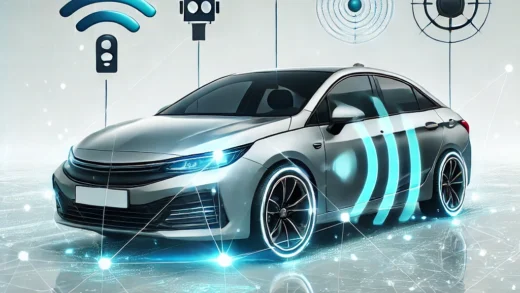
Automatic emergency braking has become one of the most important safety features in modern vehicles. Whether you drive through crowded European cities or long American highways, AEB systems play a critical role in preventing crashes by stepping in when a driver reacts too slowly. But while these systems have made driving safer overall, they also come with one frustrating flaw: false positives. These sudden, unnecessary braking events can startle drivers, disrupt traffic, and sometimes cause more danger than they prevent. Now, advances in artificial intelligence are offering a solution by making emergency braking far more accurate, more reliable and more natural for everyday driving.

Why Emergency Braking Sometimes Gets It Wrong
Emergency braking relies on sensors such as cameras, radar and lidar to detect obstacles ahead. If the system believes a collision is imminent, it applies the brakes automatically. While the core idea is simple, real-world driving isn’t. Shadows, road signs, small objects, large vehicles in nearby lanes or even overhead structures can confuse a basic detection system. In difficult environments — strong sunlight, fog, heavy traffic or road curves — the risk of misinterpretation grows.
A false positive can happen, for example, when a radar sensor picks up a stationary sign near the road and interprets it as a vehicle in the lane. It may also occur when a camera sees a plastic bag on the road and mistakes it for a solid obstacle. Even simple lane merges can cause confusion if the system thinks the car ahead is directly blocking the lane when it is actually moving away.
These sudden braking events are jarring and can cause drivers to lose confidence in safety systems that are meant to help them. In some cases, vehicles behind may not expect the sudden deceleration, increasing the risk of a rear-end collision. Reducing false positives is not just a matter of convenience — it is a critical safety priority.
How AI Makes Braking More Accurate
Artificial intelligence changes how emergency braking systems interpret the world. Instead of relying on simple rules or single-sensor input, AI can analyze a much wider variety of data and detect patterns that traditional systems miss.
AI-enhanced AEB systems process visuals from cameras, radar reflections, distance measurements and vehicle dynamics information all at once. Machine learning models are trained on millions of real-world driving scenarios, allowing them to identify what is a real danger and what is not. For example, AI can learn the difference between a shadow and an obstacle, or between a harmless roadside object and a vehicle directly ahead.
Another advantage is the ability to predict movement. Older braking systems simply react when an object appears in front of the car. AI systems instead consider how the object is moving, how fast the car is approaching, and whether both trajectories are likely to intersect. This predictive capability helps avoid unnecessary braking when another vehicle is simply changing lanes or when an object near the roadway is not actually in the car’s path.
Sensor fusion also becomes more powerful with AI. If a camera sees something unclear but radar does not detect mass or movement, the system learns to disregard the object. If both sensors detect something but with varying confidence, AI weighs the data intelligently instead of triggering immediate braking.
What This Means for Drivers
The biggest benefit is trust. When emergency braking activates only when absolutely necessary, drivers feel more comfortable letting the technology assist them. Many drivers currently disable AEB after repeated false positives, but AI can help restore confidence by reducing those frustrating moments dramatically.
Smoothness is another advantage. AI systems can apply proportional braking rather than a harsh, immediate stop. If the risk is moderate, the car may slow gently instead of slamming the brakes. If the system believes the obstacle might clear, it may warn the driver first rather than intervening instantly. This more natural behavior makes driving feel safer and less invasive.
AI also improves safety beyond false positives. It helps detect real hazards earlier and more accurately. Pedestrians stepping off curbs, bicycles weaving through traffic or fast-stopping cars become easier for the system to identify with precision. This reduces both missed detections and unnecessary braking — a winning combination.
Drivers in snowy regions, heavy rain, or high-glare environments stand to benefit even more. Weather and lighting have historically caused many false positives, but AI models trained on difficult conditions can make far better judgments than older rule-based logic.
Challenges Automakers Must Solve
Despite its promise, AI-based braking systems require high-quality sensors and well-trained models. Poor sensor calibration, lens obstruction from dirt or snow, and inconsistent data can still confuse even advanced systems. Automakers must also ensure the AI behaves consistently under rapid changes in environment.
Another challenge is regulatory testing. Because emergency braking directly affects vehicle control, these systems must meet strict safety standards. AI adds complexity, requiring transparency in how decisions are made and rigorous validation before deployment.
Finally, drivers must be educated on the capabilities and limitations of modern braking systems. Even smarter AI is designed to assist — not replace — human awareness.
The Future of Safer, Smarter Braking
As vehicles become more connected and more software-driven, emergency braking will continue to evolve. AI-powered systems will learn continuously from millions of miles of real-world driving data, becoming more reliable each year. Over-the-air updates will refine braking behavior, reduce false positives and enhance performance without requiring new hardware.
In the long run, AI-based emergency braking could become so precise that false positives become a rarity. For drivers in both the US and Europe, that means safer roads, fewer surprise stops, and greater trust in the next generation of intelligent vehicles.
In short, AI isn’t just improving braking — it’s making every trip smoother, safer and more predictable.