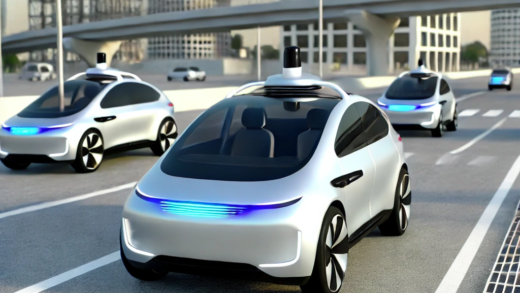
Autonomous vehicles are transforming the transportation landscape in both the United States and Europe, but their development depends on something many people never see: simulation-first validation and the creation of synthetic worlds. These virtual environments have become essential for testing, refining and validating self-driving technologies long before they reach public roads. As the automotive industry intensifies its push toward autonomy, simulation-driven development is emerging as one of the most important cornerstones of the AV ecosystem.

Why Simulation-First Development Matters?
Traditionally, autonomous vehicles were tested primarily through real-world driving. Engineers equipped cars with sensors, sent them onto public roads and gathered data to improve their systems. While road testing remains vital today, it has clear limitations. Physical roads simply cannot provide every possible scenario an AV might face. Rare events—like sudden pedestrian movement, unusual weather, unexpected obstacles or unfamiliar road layouts—may take thousands of real-world miles to encounter even once.
Simulation-first validation solves this problem. Instead of relying on unpredictable real-world conditions, developers run vehicles through digital environments where they can control every variable. A single software update can be tested across countless scenarios in minutes. This ability to repeat, modify and analyze conditions instantly makes simulation an invaluable tool for improving safety and accelerating development.
In both the US and Europe, AV companies now rely on millions of virtual miles to train and validate their systems. Simulation allows them to test edge cases, stress-test sensor performance, analyze driving behaviour and refine decision-making algorithms—all without exposing the public or test drivers to unnecessary risk.
The Power of Synthetic Worlds
At the heart of simulation-first validation lies the concept of synthetic worlds. These are highly detailed digital environments that recreate real cities, highways and suburbs with astonishing realism. Synthetic worlds simulate road geometry, weather conditions, traffic flow, signage, pedestrian behaviour and even sensor noise. They turn autonomous driving into a digital experiment where every aspect can be controlled, adjusted and measured.
For Europe, synthetic worlds are especially valuable because urban layouts vary dramatically across countries. Narrow medieval streets, inconsistent signage and multi-modal traffic patterns create challenges that must be addressed in training AI systems. Reproducing these environments digitally helps developers adapt AV algorithms for the specific characteristics of European cities.
In the United States, synthetic worlds allow AV companies to test sprawling highway networks, complex suburban intersections and rural roads that would take months to map physically. Developers can introduce unexpected events—such as road debris, aggressive drivers or lane closures—to examine how an autonomous vehicle reacts under pressure.
The best synthetic worlds combine artificial environments with real-world data, creating a hybrid model that allows AV systems to learn both realistically and creatively.
From Virtual Testing to Real-World Validation
One of the biggest advantages of simulation is its ability to validate changes quickly. When engineers modify an algorithm or add a new sensor model, they can immediately run regression tests across thousands of scenarios. This helps ensure that updates improve performance without creating new errors.
In the regulatory environment, especially in Europe, simulation-first validation is becoming a key step toward approval. Authorities increasingly recognise the value of digital testing, as it allows companies to demonstrate safety and readiness before vehicles interact with the public. Synthetic testing scenarios are being used to support applications for on-road trials, helping bridge the gap between laboratory testing and real-world deployment.
In the US, where regulation varies at the state level, simulation helps companies build trust with local authorities, investors and the public. AV developers can share simulation data to show how their systems behave in dangerous or rare conditions that would be difficult to test on physical roads.
Benefits for Automakers and AV Developers
A simulation-first mindset gives companies significant advantages as they compete to bring autonomous vehicles to market. It dramatically reduces development time by allowing teams to test new ideas instantly. It also lowers cost by eliminating the need for large fleets of physical test vehicles. Perhaps most importantly, simulation provides access to unlimited scenario variety, enabling developers to train AV systems in conditions they might never experience in controlled track testing.
Automakers integrating advanced driver-assistance systems benefit as well. They can validate ADAS features—such as lane-keeping, adaptive cruise control and automated braking—within synthetic environments to ensure performance and reliability before vehicles reach customers.
Simulation also enhances collaboration. Engineers, AI specialists and regulatory teams can work within the same virtual framework, analyzing data and making informed decisions based on realistic models.
Challenges and the Path Forward
Despite enormous progress, simulation-first validation still faces challenges. One of the biggest is closing the gap between synthetic and real-world performance. Digital models must accurately reflect sensor behaviours, vehicle dynamics and human unpredictability. If simulations are not tuned correctly, they may lead to misleading conclusions.
Another challenge is standardization. As the US and Europe develop clearer regulatory guidelines for simulation-based validation, companies will need to align on which tests, environments and metrics qualify as acceptable evidence of safety.
However, the industry is rapidly addressing these challenges. Improvements in physics-based modeling, AI-driven scenario generation and high-resolution mapping are narrowing the sim-to-real gap. Regulators are increasingly open to simulation data, especially when combined with real-world testing.
The Future of AV Development
Simulation-first validation and synthetic worlds are not just tools—they are becoming the foundation of autonomous vehicle development. As AV technology matures, virtual testing will support every stage of the lifecycle, from early design to continuous updates deployed over the air. The industry is moving toward a future where safety, speed and innovation rely as much on digital intelligence as on physical road testing.
In both the US and Europe, synthetic worlds are shaping a safer, smarter and more efficient path to autonomy. As companies embrace simulation-first strategies, the race toward fully autonomous mobility will accelerate, bringing us closer to a future where self-driving vehicles are a natural part of everyday life.