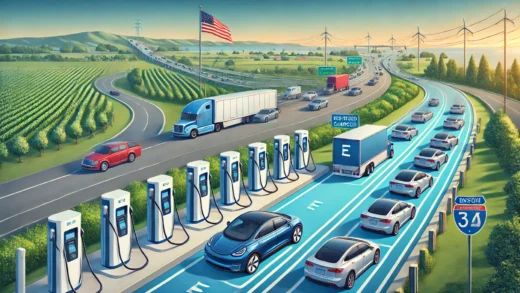
Every few months, headlines promise the holy grail of electric mobility: the “5-minute charge.” The idea is simple and seductive. Pull into a station, plug in, grab a coffee, and drive away with a full battery before your cup cools. But between marketing buzz and engineering reality, there’s a wide gap.
In the U.S. and Europe, automakers and charging networks are moving toward 800-volt EV architectures and 400 kW chargers, which represent the next step in ultra-fast charging. But what do these numbers mean in practice, and how close are we to true 5-minute refueling?

What 800V and 400 kW Really Mean?
Most EVs today use 400-volt systems. An 800-volt system doubles the voltage, letting more power flow at lower current. That means less heat, thinner cables, and the ability to handle much higher peak charging rates—potentially 300 to 400 kW in short bursts.
A 400 kW charger is the kind of equipment that can, in theory, add hundreds of kilometers of range in minutes. The European Union has already legislated for charging pools of at least 400 kW every 60 kilometers along the core highway network by 2026. Networks such as IONITY are installing 350–400 kW units across Europe, preparing for vehicles capable of taking full advantage.
In the U.S., newer networks like IONNA are planning hubs equipped with 400 kW chargers that work with both CCS and Tesla’s NACS connectors. The hardware is coming—but that doesn’t mean 5-minute charging is around the corner for everyone.
Why “5-Minute” Charging Is Harder Than It Sounds?
There are several bottlenecks between the promise and the reality.
The first is the grid. Delivering 400 kW to even one car requires huge amounts of electricity. Multiply that across several vehicles charging at once, and a single site can demand as much power as a small town. Many locations don’t have that capacity without expensive grid upgrades.
Heat is another challenge. High-power charging stresses both cables and batteries. Liquid-cooled cables are already being used to handle the load, but the battery itself also needs advanced thermal management. Without it, charging speed tapers quickly to protect the cells.
Then there’s the chemistry. Most lithium-ion batteries simply can’t take ultra-high power continuously. They charge fastest when nearly empty, then slow down dramatically as they fill. That’s why many EV makers advertise “10–80% in 18 minutes” rather than “full in five.” To achieve 5-minute charging, new chemistries like silicon-anode or solid-state batteries would need to mature.
Finally, there’s standardization. Not all EVs are built to handle 800V. Porsche Taycan, Hyundai Ioniq 5, Kia EV6, and Lucid Air are among the few today. Most cars on the road run on 400V, and while they can use high-power chargers, they won’t reach those headline speeds.
Europe’s Advantage
Europe is slightly ahead thanks to regulation. The Alternative Fuels Infrastructure Regulation (AFIR) requires minimum power levels and distances for chargers along major highways. That creates certainty for networks and ensures consistency for drivers.
IONITY, backed by automakers like BMW, Mercedes, and Volkswagen, is already rolling out 400 kW units. Some countries, like Norway and the Netherlands, are even trialing charging hubs that integrate renewable energy and battery storage to balance grid demand.
For drivers in Europe, this means that within a few years, stopping at a highway hub and adding 200–300 kilometers of range in 15 minutes will become normal. True “5-minute” top-ups, however, will remain rare.
The U.S. Catch-Up Game
In the U.S., things are more fragmented. Federal programs like the National Electric Vehicle Infrastructure (NEVI) fund are rolling out chargers along interstate corridors, but many are still capped at 150–350 kW. Permitting delays, utility interconnections, and uneven state policies all slow progress.
Private investment is filling some gaps. IONNA—a joint venture of major automakers—plans thousands of 400 kW stations. Tesla’s Supercharger network already offers consistent high-power charging, though most stalls currently max out around 250–350 kW. Upgrades to higher-power V4 Superchargers are underway.
Still, deployment is uneven. Urban areas and busy corridors are prioritized, while rural highways may lag behind. For now, most U.S. drivers will still spend 20–30 minutes charging on long trips.
What Drivers Should Expect?
Over the next five years, charging times will keep shrinking, but not quite to 5 minutes. In Europe, expect more 800V-capable hubs where premium EVs can add major range in under 20 minutes. In the U.S., expect growing access to 350–400 kW chargers on interstates, though whether your car can use them fully is another story.
Real-world charging will still depend on battery size, chemistry, and state of charge. For most drivers, “fast enough” will mean adding hundreds of kilometers in the time it takes for a restroom stop and coffee break—not a stopwatch-measured pit stop.
Bottom Line
The 5-minute charge is more aspiration than reality today. But the combination of 800V vehicle platforms, 400 kW chargers, and regulatory support is steadily pushing EV charging closer to the convenience of refueling.
Europe’s regulatory push gives it a head start. The U.S. is catching up through a mix of federal programs and private investment, though unevenly. For now, EV shoppers should look closely at their car’s charging architecture and local network availability rather than dreaming of 5-minute miracles.
The future is bright, though. By the end of the decade, stopping for 10–15 minutes to gain hundreds of kilometers will feel normal. That may not be “5 minutes,” but it’s close enough to make EV road trips simple, stress-free, and nearly as quick as pumping gas.
This is a topic which was posted on Reddit and here is the link to the reddit post – https://www.reddit.com/r/electricvehicles/comments/1musytr/why_cant_the_us_build_5minute_ev_chargers/