In the ever-evolving automotive market, there’s one thing investors can always count on: volatility. As electric vehicles (EVs), smart mobility, and autonomous tech continue to disrupt the industry, automotive stocks have been riding waves of speculation and hype. But while some companies are proving their worth with strong fundamentals and sustainable growth, others may be priced far beyond their true value.
If you’ve been closely following the automotive sector in the U.S. and Europe, you’ve likely noticed a handful of stocks that have surged on future potential, but now face increasing scrutiny from analysts. The question many investors are asking is: are these overvalued automotive stocks reaching their peak, and is it time to cash out?
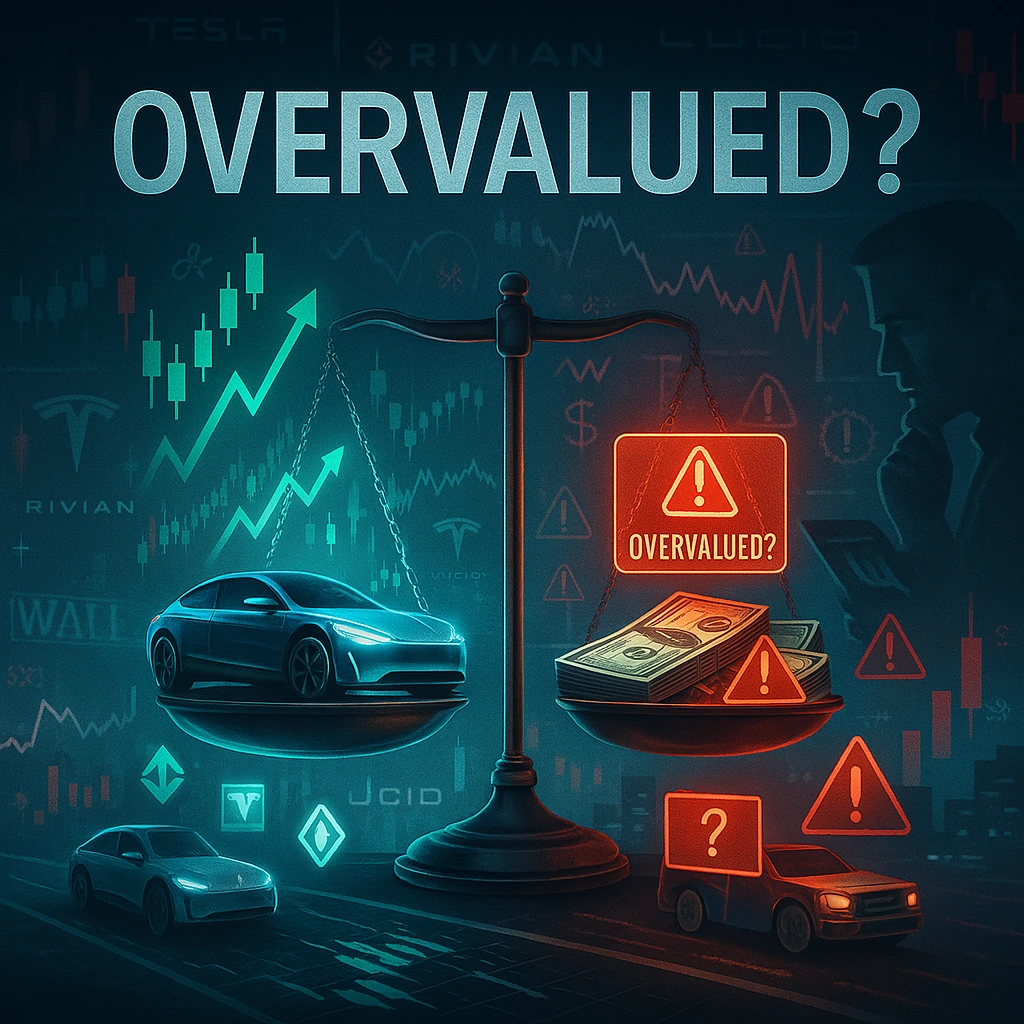
When Market Hype Outpaces Fundamentals
The automotive industry is no stranger to investor excitement, especially as electric vehicles dominate headlines and legacy carmakers announce aggressive pivot strategies. But enthusiasm can be a double-edged sword. It’s not uncommon for share prices to climb well ahead of a company’s actual earnings performance, leading to inflated valuations that might not hold up in the long run.
Some EV-focused automakers, in particular, have seen extraordinary market caps without yet delivering sustainable profits or meaningful vehicle volumes. While innovation is a key driver of future value, valuation metrics like price-to-earnings (P/E) ratios, revenue growth, and market share must support the story. Otherwise, the market correction can be swift and painful.
Tesla, for instance, remains the most prominent example. While its role in shaping the EV market is undeniable, some analysts argue that its current valuation is stretched, especially amid rising competition and margin pressure from price cuts. Although Tesla continues to lead in software and autonomous driving capabilities, questions about long-term demand, global production costs, and slowing delivery growth have led some investors to reassess their positions.
Startups That Still Need to Prove Themselves
Another area that deserves a cautious eye is the collection of relatively new EV startups. Companies like Lucid Motors and Fisker entered the public market with high expectations, bolstered by sleek vehicle concepts and strong pre-order numbers. However, production delays, supply chain issues, and high cash burn have made it difficult for these companies to meet investor expectations.
Lucid, known for its luxury EV sedan, has struggled to ramp up production in line with its lofty forecasts. While its technology has won praise, its limited scale and reliance on significant capital injections raise questions about how long it can sustain current valuations without stronger financial performance.
Fisker, with its more affordable EV offerings, also faces mounting challenges. Despite promising partnerships and a clear branding strategy, consistent delivery delays and quality concerns have impacted investor confidence. In such cases, valuations that were once justified by potential are now weighed down by execution risk.
Legacy Carmakers Priced Like Tech Giants?
Legacy automakers are another area to watch. Companies like Ford and General Motors have surged in recent years thanks to ambitious EV roadmaps and major investments in battery technology. While these moves are critical for long-term relevance, some valuations may have temporarily run ahead of actual business transformation.
Ford’s stock, for instance, benefited from early excitement around its Mustang Mach-E and the electric F-150 Lightning. However, recent margin pressures, rising costs for battery materials, and slowing demand in some global markets have triggered a more cautious outlook from analysts. GM’s push into autonomous vehicles through Cruise and electric trucks like the Silverado EV also drew attention, but full-scale commercialization remains a few years away.
Investors need to evaluate whether these companies’ stock prices still reflect real performance or if they’re inflated by speculative sentiment. While it’s encouraging to see legacy carmakers embrace innovation, transforming decades-old manufacturing models takes time, and the road is rarely smooth.
Supply Chain Risks and Global Uncertainty
It’s also important to consider the macroeconomic and geopolitical context. Automotive companies across the U.S. and Europe continue to face supply chain disruptions, semiconductor shortages, and shifting raw material costs. Lithium prices, crucial for EV battery production, have fluctuated significantly, putting pressure on manufacturers.
Additionally, regulatory environments remain in flux. From evolving emissions standards in Europe to EV tax credit reforms in the U.S., policy shifts can significantly impact profitability and production decisions. If a stock’s valuation is heavily reliant on favorable policy conditions or government incentives, investors should be cautious and prepare for potential shifts.
How to Decide Whether to Sell
Selling an overvalued stock isn’t just about identifying a peak price—it’s about recognizing when the underlying growth story no longer supports the valuation. If a company’s revenue growth has stalled, production timelines are constantly delayed, or margins are shrinking despite rising stock prices, it may be time to take profits.
Look for signs of overexposure to speculative trends, excessive marketing without product delivery, and reliance on short-term hype. Also, consider diversification. If your portfolio is heavily weighted toward high-risk automotive stocks, trimming some positions could protect your gains while freeing up capital for more stable investments.
What’s Next for Automotive Investors?
The future of mobility is undoubtedly exciting. From electrification to connected vehicles and autonomous driving, the industry is full of transformative potential. But long-term success will favor companies with clear execution, scalable technology, and sound financial management.
Investors who stay grounded in fundamentals and resist the noise of hype cycles will likely emerge with stronger, more resilient portfolios. While there’s nothing wrong with riding momentum for short-term gains, understanding when valuations no longer match reality is key to making smart investment decisions.
So, is it time to sell some of those overvalued automotive stocks? If your investment was based on a bold vision that hasn’t materialized—or worse, has started to unravel—it might be time to take a step back and rebalance. In a market defined by disruption, timing your exit can be just as important as picking the right entry point. Stay informed, stay flexible, and always invest with clarity.