

The race toward fully autonomous driving has brought two industry giants, Waymo and Tesla, to the forefront. Both companies are revolutionizing how we think about mobility, yet they approach the challenge of self-driving technology from vastly different angles. In this blog, we’ll explore the key differences, strengths, and limitations of Waymo’s autonomous driving system and Tesla’s FSD 13, offering insights into how they shape the future of transportation in the US and Europe.
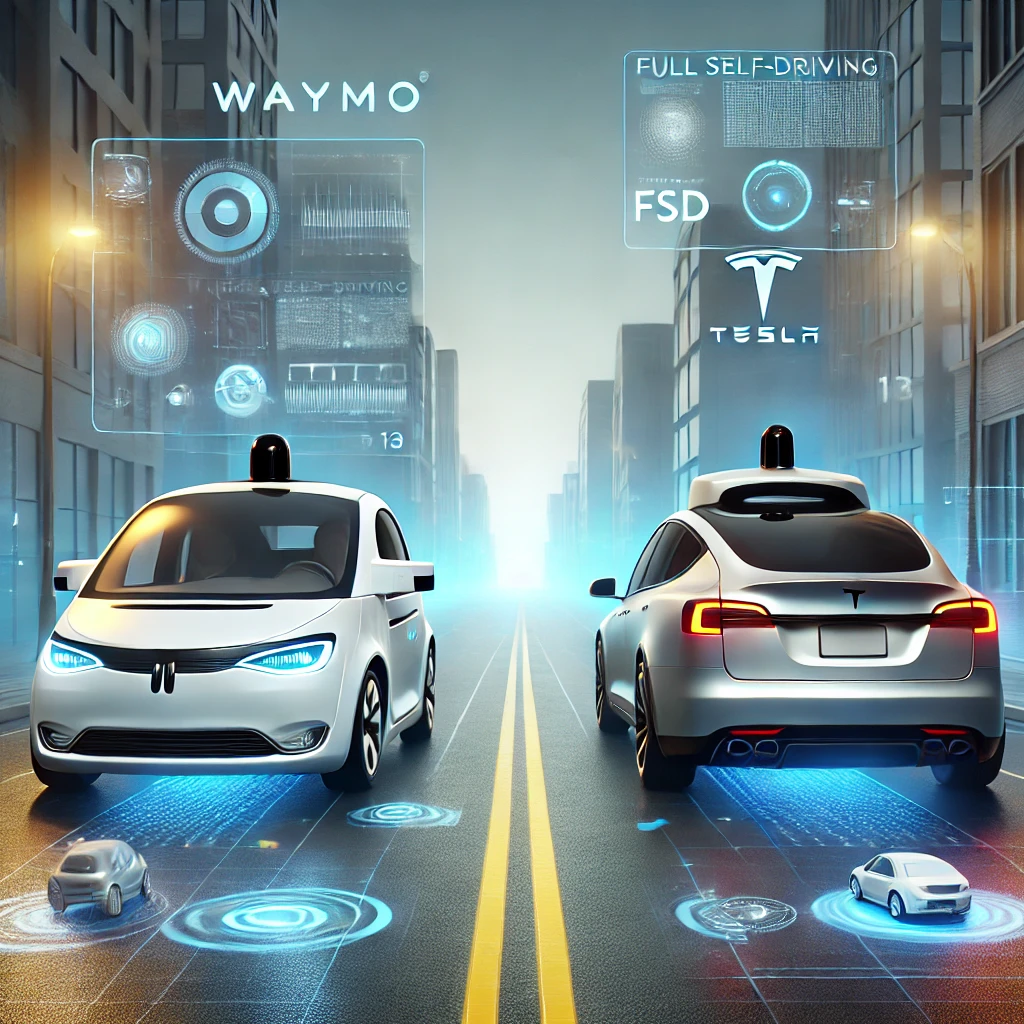
Waymo: Precision and Safety First
Waymo, a subsidiary of Alphabet, has positioned itself as a leader in autonomous driving, focusing heavily on safety and reliability. Its self-driving technology is built upon years of research and billions of miles of real-world and simulated driving. Waymo has invested in creating a fleet of purpose-built vehicles equipped with advanced LiDAR, radar, and camera systems, all designed to interpret the world with unparalleled precision.
The hallmark of Waymo’s approach is its Level 4 autonomy, which allows vehicles to operate entirely without human intervention in pre-mapped areas. Waymo’s operations are currently limited to specific cities in the US, where it offers ride-hailing services in areas that have undergone extensive mapping and testing.
Waymo’s strength lies in its cautious approach. By limiting its operations to geofenced areas, it minimizes risks and maximizes performance in environments it knows well. This strategy ensures a higher degree of safety and reliability, making it a trusted choice for those experiencing autonomous rides for the first time.
Tesla FSD 13: The All-Around Innovator
Tesla takes a more ambitious approach with its Full Self-Driving (FSD) system, aiming for a scalable solution that works across diverse environments. FSD 13 represents the latest iteration of Tesla’s autonomous driving software, building on the company’s existing infrastructure of AI-powered vision and machine learning.
Tesla’s vehicles rely on a camera-based system, eschewing LiDAR in favor of a vision-first approach. This decision aligns with Tesla’s philosophy that the world should be navigated as humans do—using visual cues rather than specialized sensors. The result is a system capable of continuously improving through real-world data collected by Tesla’s global fleet of vehicles.
The standout feature of FSD 13 is its versatility. Tesla’s software isn’t limited to specific cities or geofenced areas. It’s designed to handle a wide range of scenarios, from highways to dense urban streets. However, it’s important to note that Tesla’s FSD is still considered Level 2 autonomy, requiring drivers to remain attentive and ready to take over at any time.
Technology Showdown: LiDAR vs. Vision-Based AI
One of the most notable differences between Waymo and Tesla lies in their approach to sensing and perception. Waymo’s reliance on LiDAR gives it a precise, 3D understanding of its surroundings, which enhances safety and reliability in controlled environments. This high-tech sensor suite allows Waymo to create detailed maps of its operating zones, enabling it to perform flawlessly in geofenced areas.
On the other hand, Tesla’s vision-based system relies solely on cameras, radar, and neural networks. This approach makes Tesla’s vehicles more adaptable to a wider variety of road conditions and environments without requiring pre-mapping. Tesla’s reliance on real-time learning gives it a distinct edge in scalability, as the fleet constantly gathers and processes new data to improve the software’s performance.
Both approaches have their merits. Waymo’s use of LiDAR ensures pinpoint accuracy in mapped regions, but it comes at a high cost and limits scalability. Tesla’s vision-based system is less expensive and more flexible, but it still faces challenges in achieving the same level of precision under certain conditions, such as poor weather or complex urban scenarios.
US and Europe: Different Roads, Different Challenges
In the US, both Waymo and Tesla are shaping the autonomous driving landscape in unique ways. Waymo’s ride-hailing services are particularly popular in tech hubs like California and Arizona, where it operates a growing fleet of autonomous taxis. Tesla, with its broader market reach, appeals to individual car owners looking to experience semi-autonomous driving across the country.
In Europe, the adoption of autonomous vehicles presents additional challenges due to stricter regulations and more intricate road networks. Tesla’s FSD 13 is making gradual progress in Europe, where its vision-based system adapts well to the continent’s diverse driving environments. Waymo’s expansion into Europe may face hurdles due to the need for extensive mapping and testing in highly varied terrains and legal frameworks.
The Future of Autonomous Driving
Waymo and Tesla represent two distinct philosophies in the race toward autonomy. Waymo focuses on precision and safety within controlled environments, delivering a near-flawless Level 4 experience for its users. Tesla, on the other hand, pushes the boundaries of innovation with its scalable, vision-based FSD system, aiming for a future where autonomy is accessible to all.
As both companies continue to refine their technologies, the future of driving looks increasingly autonomous. Waymo’s cautious, safety-first approach could make it the gold standard for urban ride-hailing, while Tesla’s ambitious, global vision may redefine personal mobility.
Whether you prefer Waymo’s careful precision or Tesla’s bold innovation, one thing is certain: the road ahead is full of exciting possibilities. As autonomous driving technology matures, it’s not a question of if, but when, these systems will become a seamless part of everyday life in the US, Europe, and beyond.


