

Electric vehicles (EVs) are revolutionizing the way we think about transportation, offering a cleaner and more sustainable alternative to traditional cars. However, the surge in EV adoption brings an important question to the forefront: What happens to the batteries after their life cycle? Recycling and disposal of EV batteries are crucial not only for environmental sustainability but also for securing the resources needed to power future EVs. In 2024, Europe and the United States stand at different points on this critical issue, each approaching the challenge with its unique strategies.
Europe’s Proactive Policies on EV Battery Recycling
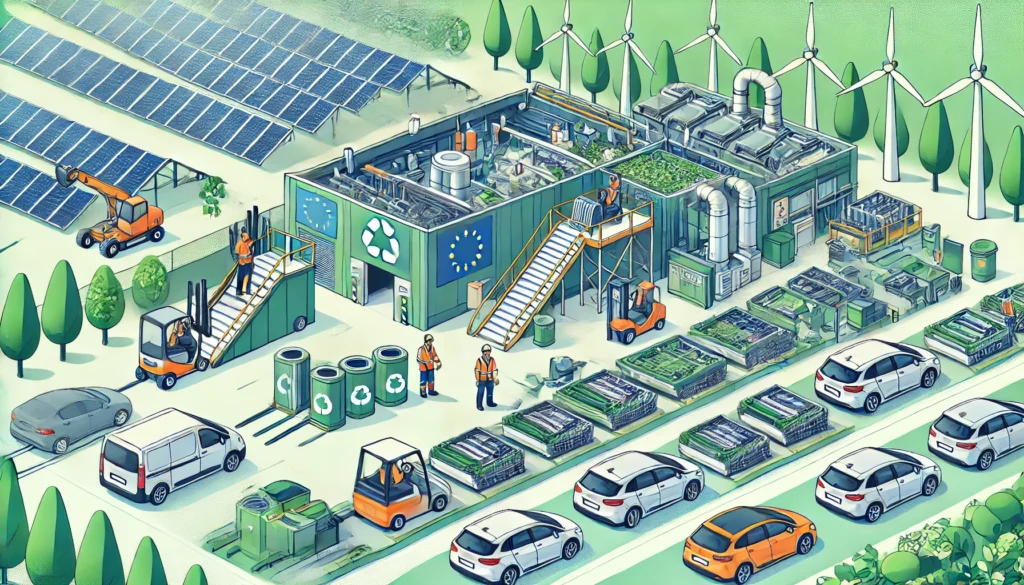
Europe has positioned itself as a global leader in tackling the challenge of EV battery recycling and disposal. With stringent environmental policies and a strong focus on sustainability, the EU has rolled out comprehensive regulations aimed at ensuring that EV batteries are handled responsibly.
One of the cornerstones of Europe’s approach is the updated EU Battery Regulation, which went into effect in January 2024. This regulation mandates that EV batteries must meet strict recycling quotas. Manufacturers are required to recover at least 70% of lithium and 95% of cobalt, nickel, and copper from old batteries by 2030. This forward-looking framework not only minimizes waste but also addresses the critical need for rare earth materials.
European countries are also fostering public-private partnerships to create advanced recycling infrastructure. Companies like Northvolt in Sweden are pioneering innovative recycling processes, while Germany has established dedicated battery recycling plants equipped with cutting-edge technology. These efforts underscore Europe’s commitment to creating a circular economy, where raw materials are reused instead of discarded.
The US: A Market-Driven Approach to EV Battery Disposal
In contrast to Europe’s regulatory-heavy approach, the United States has opted for a market-driven strategy in handling EV battery recycling and disposal. While federal guidelines are in place, they are often less stringent, leaving much of the responsibility to state governments and private companies.
In 2024, the US continues to face challenges in scaling its battery recycling infrastructure. Unlike Europe, where centralized policies encourage cohesive efforts across member states, the US grapples with a fragmented system. States like California and New York are leading the charge with stricter recycling mandates, but other regions lag behind.
However, the US isn’t entirely falling behind. Tech companies and automakers, including Tesla and Redwood Materials, are investing heavily in closed-loop recycling systems. Redwood Materials, for instance, aims to recycle up to 95% of key materials like lithium, cobalt, and nickel, similar to European benchmarks. Despite these efforts, the lack of nationwide regulations has slowed progress compared to Europe.
Comparing Recycling Technologies
Europe and the US both rely on advanced recycling technologies to process EV batteries, but their approaches differ in scale and implementation. Europe has embraced hydrometallurgical recycling, a process that uses chemical solutions to extract valuable metals. This method is not only efficient but also eco-friendly, making it a preferred choice for meeting the EU’s ambitious recycling targets.
In the US, pyrometallurgical recycling—using high-temperature furnaces to extract materials—is still more common. While effective, this method has a higher carbon footprint compared to Europe’s solutions. However, US companies are catching up by adopting more sustainable practices. Efforts to commercialize innovative technologies like direct recycling, which allows for the reuse of entire battery components, are gaining momentum.
Resource Security: A Shared Priority
Both Europe and the US recognize the strategic importance of securing resources for future EV production. With the global demand for lithium and other rare metals soaring, recycling is no longer just an environmental imperative; it’s also an economic necessity. Europe’s coordinated efforts have already created a more resilient supply chain, reducing dependence on imports.
In the US, resource security is becoming a focal point in policy discussions. The 2024 Inflation Reduction Act has incentivized domestic production and recycling of critical materials, aiming to bolster the nation’s EV industry. While these efforts are promising, the US still has ground to cover in building a comprehensive, national-level strategy.
The Road Ahead
As EV adoption accelerates, the need for effective battery recycling and disposal will only grow. Europe’s regulatory framework offers a blueprint for other regions, emphasizing the importance of unified policies and sustainable practices. Meanwhile, the US’s innovation-driven approach highlights the role of private industry in shaping the future of recycling technologies.
For both regions, collaboration could be the key to addressing this global challenge. By sharing knowledge and best practices, Europe and the US can drive innovation and set new standards for sustainability in the EV industry.
The race to recycle EV batteries is more than a competition; it’s a shared mission to protect our planet and ensure the longevity of the electric revolution. As we move through 2024, the question is not just who will lead but how the world can collectively rise to meet this challenge.


