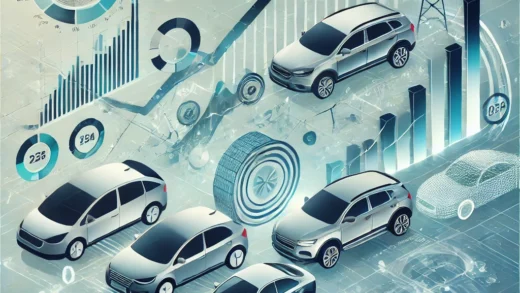
When you picture a “smart road,” you might imagine a highway that warns your car of an icy patch ahead, coordinates traffic lights to eliminate jams, or even charges your electric vehicle while you’re driving. That may sound futuristic, but in the United States and Germany, these ideas are already being tested. Smart infrastructure and connected roads are not just buzzwords; they are becoming central to how both countries envision the future of mobility.

What Do Connected Roads Mean?
A connected road is more than asphalt and concrete. It is embedded with sensors, cameras, and communication devices that link directly to vehicles and traffic management systems. These roads can share data about traffic conditions, hazards, weather, and accidents in real time. Cars equipped with the right technology can then react faster, or in some cases, autonomously, making travel safer and smoother.
In simple terms, it’s like giving roads a brain and a voice. Instead of reacting only to what a driver sees, vehicles get advanced warnings and can make smarter decisions. As adoption grows, connected roads promise fewer crashes, shorter commutes, and more efficient use of energy.
The US: Test Corridors and Bold Pilots
In the United States, smart road projects often begin as pilots. Michigan, long seen as the hub of America’s auto industry, is leading the way with a smart stretch of Interstate 94. Along this corridor, poles fitted with sensors and computing units collect and transmit real-time data about traffic, weather, and hazards. Cars traveling the highway can receive this information instantly, creating a safer and more predictable driving environment.
Companies like Cavnue are working hand in hand with state governments to turn these test corridors into scalable solutions. In Texas, plans are underway for a connected freight corridor designed to optimize trucking efficiency and reduce risks for heavy vehicles.
The federal government also plays a role through initiatives like Safe Streets for All, which promotes intelligent transportation systems nationwide. These include adaptive traffic lights, automated incident detection, and predictive analytics to anticipate where accidents might occur.
Still, the U.S. faces challenges. With its vast road network and decentralized governance, scaling these systems nationwide requires agreement on technical standards and major investment. A smart road in Michigan should ideally work seamlessly with a vehicle made in California—or even in Germany.
Germany: Engineering Precision and Legal Frameworks
Germany’s approach to smart infrastructure combines engineering rigor with regulatory clarity. In 2021, the German government passed a law allowing autonomous cars and buses to operate in defined areas without needing special permits. This legal shift laid the groundwork for integrating connected and automated vehicles into daily life.
German automakers and suppliers are already leaders in connected-car technology. Many vehicles now communicate with traffic lights or receive warnings from road sensors. Pilot projects are also exploring futuristic concepts such as roads that charge electric cars while they drive, using inductive coils embedded beneath the surface.
Partnerships play a big role too. Verizon and Audi recently announced a project to equip an Audi test track in Germany with 5G, allowing vehicles to test and refine connected driving features. This cross-border collaboration shows that smart infrastructure is a truly global effort.
Yet challenges remain. Germany’s regulatory system is thorough, which ensures safety but slows down deployment. Questions of liability—who is responsible if an autonomous car on a smart road has an accident—are still being debated. Public trust also needs to be earned through transparency and proven reliability.
Shared Challenges on the Road Ahead
Both the U.S. and Germany face similar obstacles in building connected road networks. The first is communication technology. For smart roads to work, data must flow instantly and securely. Whether through 5G, dedicated short-range communication, or evolving cellular vehicle-to-everything standards, connectivity must be reliable and cyber-secure.
Another challenge is retrofitting. Most existing roads were not designed for sensors or embedded communication systems. Finding cost-effective ways to upgrade infrastructure—sometimes by repurposing lamp posts or existing utility poles—will be essential.
Standards and interoperability are also critical. A connected car in Germany should be able to interact with infrastructure in the U.S., and vice versa. Without shared protocols, the benefits of smart infrastructure will be limited.
Finally, financing remains a key question. Governments, private companies, and public-private partnerships all have roles to play, but large-scale deployment requires sustainable business models. The benefits—fewer accidents, faster commutes, cleaner mobility—are clear, but the upfront costs are substantial.
What Each Country Can Learn From the Other?
The U.S. excels in experimentation. Test corridors and pilots allow quick learning, real-world testing, and flexibility. This makes it easier to trial bold ideas, such as dedicated smart freight routes.
Germany, on the other hand, brings consistency and depth. Its regulatory framework ensures that connected systems are safe, reliable, and integrated with the broader transportation ecosystem.
By combining these strengths—America’s agile experimentation with Germany’s disciplined approach—both countries can accelerate progress. Shared standards, cross-border collaboration, and partnerships between automakers and technology providers will be crucial.
The Road Ahead
Smart infrastructure and connected roads will not replace traditional highways overnight. Instead, they will appear gradually, starting with high-value corridors and urban areas where benefits are greatest. For drivers, the change will be subtle at first: fewer traffic jams, warnings of hazards ahead, more synchronized traffic lights. Over time, as more vehicles and roads connect, the driving experience will transform into something smoother, safer, and more efficient.
In both the U.S. and Germany, progress is being made mile by mile. From Michigan’s connected highway to Germany’s wireless charging experiments, the building blocks of tomorrow’s roads are already here. A decade from now, when your car adjusts speed before you even see the slowdown ahead, you’ll know the road is thinking right along with you.